China Top 10 Clear Glass Jar Manufacturers
Clear Glass Jar packaging remains a practical choice for food, beverage, cosmetic, and home-care brands. Its transparency lets buyers inspect color, texture, and fill level before opening. Yet appearance is only part of the decision. A jar must also suit the product, filling line, closure, transport conditions, and target price. Small details matter: a rim that seals poorly or a base that chips can disrupt an otherwise polished package.
Industry data helps explain why glass remains relevant. FEVE’s 2022 report put the European Union’s glass packaging recycling rate at 80.1%. That figure describes packaging across the region, not clear jars alone. It still signals the value buyers place on established glass-recovery systems. Scott DeFife, president of the Glass Packaging Institute, has described glass as “infinitely recyclable without loss of quality or purity.” Recyclability, however, does not guarantee that every jar has the same composition, finish, or production consistency.
This guide introduces ten China-based manufacturers for buyers comparing clear glass jars. It considers product range, customization, manufacturing capabilities, quality documentation, and export experience. A supplier’s catalog can look convincing on screen. Request samples, confirm dimensions and tolerances, and discuss closure compatibility before placing a large order. Ask how the factory handles inspection and production changes, too. These checks cannot remove every risk. They can make comparisons more grounded, and help buyers identify suppliers suited to their packaging needs.
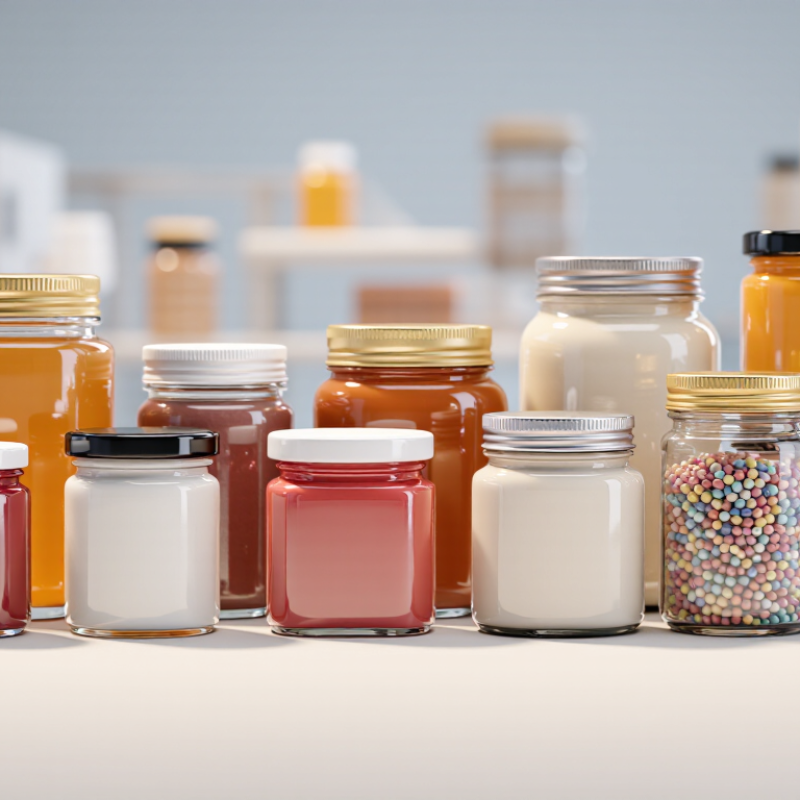
Clear Glass Jars: Definitions, Formats, and Common Packaging Uses
Clear glass jars are rigid containers made from transparent glass, with a wide opening and a separate lid or closure. Their transparency lets shoppers inspect color, texture, and fill level without opening the package. Glass also resists absorbing many food odors, though it can break if dropped. That trade-off matters.
Common formats include straight-sided jars, round jars, square jars, and hexagonal jars. Straight sides make labels easier to apply and contents easier to scoop. Short, wide-mouth jars suit spreads, spices, and small portions. Taller jars can hold sauces, preserves, dry goods, or cosmetic creams. Neck shape, opening diameter, wall thickness, and closure fit all affect filling and everyday use. A jar that looks sturdy may still feel awkward to grip when wet.
Tips: Match the opening to the product and the user’s routine. For chunky contents, choose a mouth wide enough for a spoon. Check that the lid closes evenly, and test sample jars with the actual filling before choosing a format. Clear glass displays contents well, but it also exposes products to light; sensitive items may need protective storage. Labels can wrinkle on curved surfaces. Small details, but easy to overlook.
Clear Glass Jar Formats and Common Packaging Uses
Representative nominal capacities for common clear glass jar applications. Actual sizes vary by product and supplier; these examples are not market-share data.
Soda-Lime Glass Typically Contains 70–74% Silica
Soda-lime glass typically contains 70–74% silica by weight, according to the European Commission Joint Research Centre’s 2013 Best Available Techniques Reference Document for the Manufacture of Glass. Silica forms the glass network, while soda helps the batch melt at lower temperatures. Lime supports chemical durability. The proportions vary with the recipe. A clear jar is not just “mostly sand.”
For manufacturers comparing clear glass jars, this composition affects processing as well as appearance. The USGS 2025 Mineral Commodity Summaries identifies glassmaking as a principal use of industrial sand and gravel, the main commercial source of silica. Sand purity matters: iron impurities can tint glass, while batch controls help maintain consistent clarity and forming behavior. Small differences show up. A jar’s wall may look faintly green under bright light, even when the glass is sold as clear. The silica percentage alone cannot predict performance; recycled glass, minor oxides, and furnace conditions also influence the finished container. That detail is easy to overlook.
Jar Production: Glass Melts at About 1,500°C Before Forming
Clear glass jars begin as measured batches of silica sand, soda ash, and limestone. In the furnace, the mixture reaches about 1,500°C and becomes a glowing, viscous melt. The U.S. EPA’s AP-42 glass-manufacturing profile reports furnace temperatures of roughly 1,315–1,590°C, depending on the process. The European Commission’s 2013 glass-manufacturing BREF also describes high-temperature melting as a core production stage.
Heat alone does not make a good jar. Operators must control the melt’s temperature and remove trapped bubbles before forming. The molten glass then passes through a feeder, which cuts it into small, hot gobs. Each gob drops into a metal mould, where compressed air shapes the jar’s body and neck. It is intense. Even small temperature shifts can affect flow, wall thickness, and clarity.
Freshly formed jars are still hot and vulnerable. They move through an annealing lehr, where controlled cooling reduces internal stress. That step is easy to overlook, yet uneven cooling can leave weaknesses that appear later. A clear jar may look simple on a shelf; its consistency depends on careful control from furnace to cooling line. The 1,500°C figure is useful, but it hides the practical challenge: keeping heat steady across a continuous process.
Cullet Recycling: Each 10% Increase Can Cut Melting Energy by 2–3%
China Top 10 Clear Glass Jar Manufacturers
For clear glass jars, recycled cullet is more than a sustainability claim; it is a melting-furnace input. The Glass Packaging Institute reports that replacing 10% of raw materials with recycled glass can lower energy use by about 2–3%. Small shift. At production scale, less energy is needed to heat the batch, though actual savings vary with furnace design and operating conditions.
Cullet also melts at a lower temperature than virgin glass. FEVE, the European Container Glass Federation, describes recycled glass as a key resource for reducing the sector’s energy demand and emissions. In jar production, clean, well-sorted cullet matters: ceramic fragments, stones, and heat-resistant glass can create defects. A clear jar shows them plainly. The number alone is not enough.
Manufacturers comparing suppliers should ask how recycled content is measured and how rejected cullet is handled. They should also request consistent batch and energy data, not just a headline percentage. There is a practical tension here: increasing cullet can reduce melting energy, but inconsistent supply may complicate color control and quality checks. That part deserves scrutiny. The 2–3% figure is a useful industry benchmark, not a guaranteed result for every furnace or production run.
China Top 10 Clear Glass Jar Manufacturers - Cullet Recycling: Each 10% Increase Can Cut Melting Energy by 2–3%
The table below presents ten illustrative cullet-content scenarios for clear-glass jar production. It is an industry-focused comparison, not a ranking of manufacturers.
| Scenario | Cullet in Glass Batch | Increase from Previous Scenario | Estimated Melting-Energy Reduction per Step | Illustrative Cumulative Reduction vs. 0% Cullet | Practical Consideration |
| 1 | 0% | Baseline | — | 0% | Baseline for comparing the modeled scenarios. |
| 2 | 10% | 10 percentage points | 2–3% | 2–3% | Batch and cullet quality should be monitored. |
| 3 | 20% | 10 percentage points | 2–3% | 4–6% | Consistent cullet sizing and cleanliness support stable processing. |
| 4 | 30% | 10 percentage points | 2–3% | 6–9% | Incoming cullet should be checked for contaminants and color mix. |
| 5 | 40% | 10 percentage points | 2–3% | 8–12% | Supply consistency and furnace operating conditions affect results. |
| 6 | 50% | 10 percentage points | 2–3% | 10–15% | Higher recycled content requires suitable, reliable cullet streams. |
| 7 | 60% | 10 percentage points | 2–3% | 12–18% | Product clarity and quality requirements should guide batch design. |
| 8 | 70% | 10 percentage points | 2–3% | 14–21% | Actual achievable content depends on cullet availability and specifications. |
| 9 | 80% | 10 percentage points | 2–3% | 16–24% | Careful control of raw materials and recycled feedstock remains important. |
| 10 | 90% | 10 percentage points | 2–3% | 18–27% | This is an illustrative scenario; feasibility depends on product and plant requirements. |
China’s Top 10 Clear Glass Jar Manufacturers: Products and Selection Criteria
China Top 10 Clear Glass Jar Manufacturers: Products and Selection Criteria
Comparing China’s leading clear glass jar manufacturers means looking beyond a polished catalog. Common options include food jars, cosmetic containers, and wide-mouth storage jars, with different capacities, neck finishes, and lid fits. Ask for dimension drawings and sample specifications. Check wall thickness, rim quality, and whether the jar sits evenly on a flat surface. Small flaws matter. A rough rim can make filling or cleaning less convenient.
Tips: Request samples from several suppliers and compare them side by side. Measure height, opening diameter, and capacity. Ask how production batches are inspected and how jars are packed to limit breakage. Confirm the quoted lead time and minimum order quantity in writing.
Selection should also consider customization, communication, and consistency between samples and bulk orders. A clear jar may reveal bubbles, scratches, or uneven color more readily than colored glass. Ask suppliers to explain acceptable tolerances rather than relying on vague assurances. Review packaging details, such as dividers and carton strength, especially for long-distance shipping. A sample can look excellent, yet bulk production may differ; that possibility deserves a direct question. Don’t choose on price alone. Compare the full specification and keep the answers documented.